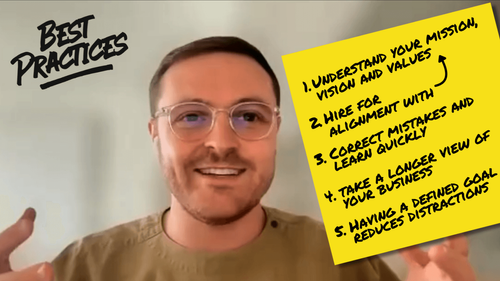
Best Practices for Jobs That Need to Be Done

Not long ago I was able to sit in on a Best Practices conversation with Steve Alexander and Cory Pinegar, CEO of Teem, and it left me questioning something most practices take for granted: that growth means doing more. More patients, more services, more hours in the chair. The conversation kept circling back to a quieter idea, that the real work of growth starts with figuring out what a practice is actually for.
Watch the episode here!
The Job Behind the Job
The framework at the center of the discussion was "Jobs to Be Done," a concept popularized by Harvard Business School professor Clayton Christensen. What I found compelling about it wasn't the theory so much as how bluntly it cuts through the noise: a business exists to solve a specific problem, not to accumulate tasks. Stepping back from the daily minutiae to ask what actually needs to get done, rather than reacting to whatever is loudest that day, is where the framework starts to earn its keep.
For a practice buried in scheduling, insurance, and staffing, that kind of stepping back can feel like a luxury. But the alternative, staying reactive indefinitely, tends to cost more in the long run than the pause would.
More Isn't a Strategy
One line from Steve stuck with me: specializing in everything essentially means specializing in nothing. Practices that chase the old "fill the chair" logic often end up hiring more staff to see more patients without the bottom line ever moving. Steve had a name for it, the practice death spiral, and once you've heard it described that way, it's hard to unsee in your own operation.
Choosing Focus Over Volume
Cory picked up that thread and took it somewhere I hadn't expected, describing the broader American instinct to stack services and effort as a kind of hamster wheel, all motion and no ground covered. His case for focus wasn't about doing less for its own sake. It was about identifying the specific jobs that actually align with a practice's vision, and letting everything else fall away. Practices that make that trade tend to see it show up in patient retention and satisfaction, not just efficiency.
Watching the Trend Line, Not Every Data Point
Both Steve and Cory returned to a challenge I've seen trip up plenty of practices: measuring success without drowning in the measuring. Analysis paralysis is a real risk once a practice starts tracking anything, and the advice here was to watch general trends rather than dissect every individual outcome. Patient recall is a good example, and one I found myself nodding along to. The value isn't in scrutinizing why one call went sideways, it's in noticing whether the broader pattern is moving in the right direction.
Keeping a Level Head
Operational setbacks provoke emotional reactions, that's just human, and I appreciated that neither Steve, nor Cory pretended otherwise. But both were clear that reacting from that place tends to produce short-term decisions that don't hold up. A supervisory perspective, one that resists the urge to overcorrect after a single bad week, keeps a practice anchored to its actual strategy. Building systems that support staff in doing their jobs well does a lot of that steadying work automatically, before emotion even has a chance to take the wheel.
Evolving Without Losing the Plot
Cory's closing point was the one I keep coming back to. Patient expectations shift, reimbursement models shift, and a practice that leans entirely on new patient volume for its profitability will eventually find that lever losing strength. The more durable path, and the one I found myself agreeing with most, balances retaining the patients already in the door with a measured pace of new growth, all while the operating model itself keeps evolving alongside it.
That, more than any single tactic from the conversation, is the real takeaway. The Jobs to Be Done framework isn't a one-time audit that you apply and set aside. It's a habit of asking, again and again, what a practice is actually here to do, and having the discipline to let that answer guide the next decision instead of whatever feels urgent in the moment. The practices that keep asking tend to be the ones still standing, and growing, when the ones still spinning their wheels start to wonder why nothing's changed.